
David moved from Chicago to Lisbon five years ago and figured that once he left U.S. soil, the IRS was somebody else’s problem. Then his Portuguese bank handed him a form asking him to confirm he was “U.S. tax compliant,” and his stomach dropped. He hadn’t filed a single U.S. return since the day he packed his bags. If you’re reading this with that same cold feeling in your gut, stop and breathe. There’s a clean, penalty-free way back, and the IRS built it for people in exactly David’s position.
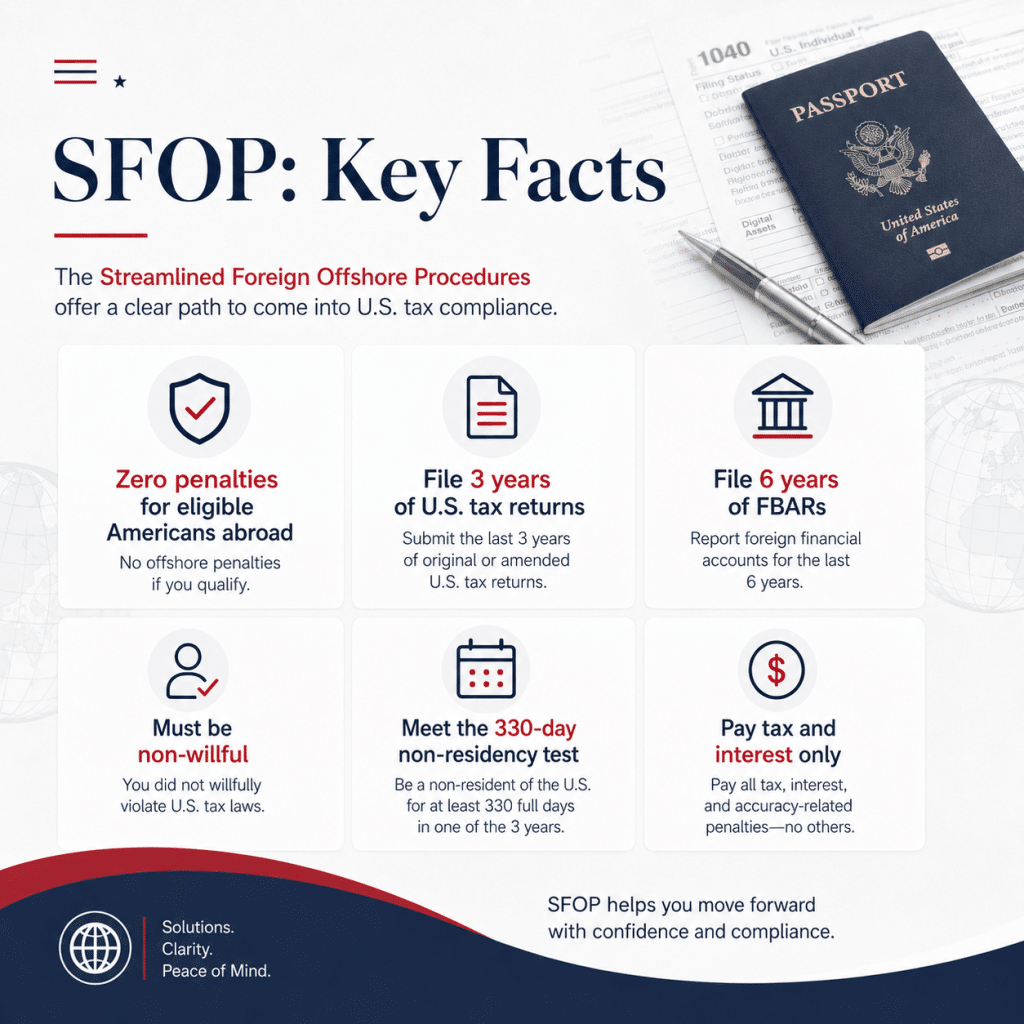
| Quick Answer:The Streamlined Foreign Offshore Procedures (SFOP) are an IRS program that lets Americans living abroad who fell behind on their U.S. tax filings catch up with no penalties — as long as the failure to file wasn’t intentional. You file three years of tax returns and six years of FBARs (foreign bank account reports), pay any tax and interest you actually owe, and sign a statement certifying your conduct was non-willful. For most expats, this is the difference between owing a little interest and facing penalties that can climb into the tens of thousands of dollars. |
What are the Streamlined Foreign Offshore Procedures?
SFOP is the “abroad” half of the IRS Streamlined Filing Compliance Procedures. There are two tracks. The foreign track (SFOP) is for Americans who live outside the United States, and it carries no penalty at all. The domestic track (SDOP), for people living stateside, charges a 5% penalty on their foreign accounts. Same idea, very different price tag — and the difference comes down to where you live.
Here’s the part that lets David sleep at night: under SFOP, the failure-to-file penalty, the failure-to-pay penalty, and the FBAR penalty all go away. You still pay the tax you genuinely owe, plus interest. But the penalties — the part that actually frightens people — are waived. That waiver is the whole point of the program.
Who actually qualifies?
Two tests decide it.
First, your conduct has to be non-willful. In plain English, that means you didn’t know, you misunderstood, you got bad advice, or you simply made a mistake — not that you knew about the rules and hid from them. David thought leaving the country ended his filing duty. That’s a textbook non-willful story.
Second, you have to meet the non-residency test. For U.S. citizens and green-card holders, that means in at least one of the last three years you had no home (what the IRS calls an “abode”) in the United States and were physically outside the country for at least 330 full days. David, who’s been in Lisbon without interruption for five years, clears that bar without thinking about it.
One hard line: if the IRS has already opened an audit or investigation into you, the door to streamlined closes. This is a program for people who come forward on their own, before the IRS comes knocking.
What do you actually have to file?
The package is more contained than most people fear. You don’t file for every year you missed — even if you’ve been gone a decade.
- Three years of tax returns (Form 1040), for the most recent years whose deadlines have passed. File in 2026 and that’s usually 2023, 2024, and 2025.
- Six years of FBARs (FinCEN Form 114), if your foreign accounts added up to $10,000 or more at any point in a year. The FBAR is the form most expats have never heard of — and the one that carries the scariest penalties. If you’re fuzzy on whether you needed one, start with our plain-English guide to FBAR for Americans abroad.
- Form 14653, the certification where you explain, under penalty of perjury, why your failure to file was non-willful. This statement is the heart of the whole submission. Get it wrong and the IRS can pull your package out of the program.
- Payment of any tax owed plus interest.
The whole thing goes in on paper to a special IRS unit in Austin, with “Streamlined Foreign Offshore” written in red across the top of each return. Not sure which years apply to your situation, or how to phrase the certification? That’s exactly the kind of thing we sort out for Americans abroad every week.
Will David owe the IRS a fortune?
Almost certainly not. Most expats owe far less than they expect, and plenty owe nothing at all. Two tools usually do the heavy lifting: the Foreign Earned Income Exclusion (around $130,000 of earned income for the 2025 tax year — confirm the current figure, since it rises each year), and the Foreign Tax Credit, which offsets your U.S. bill with tax you already paid abroad. In a higher-tax country like Portugal, those two often wipe out the U.S. tax entirely.
What you can’t avoid is interest on any unpaid tax. But interest on a small balance is nothing like the standard IRS late-filing and late-payment penalties — the ones SFOP makes disappear.
Key Takeaways
- SFOP lets non-willful Americans abroad catch up with zero penalties — you pay only the tax and interest you actually owe.
- You file three years of returns and six years of FBARs, no matter how many years you’ve been behind.
- You must meet the 330-day non-residency test and certify your conduct was non-willful on Form 14653.
- You can’t use it once the IRS has already started an audit or investigation — coming forward first is everything.
- The FEIE and Foreign Tax Credit mean most expats owe little or nothing in actual tax.
FAQ
I’ve been abroad and not filing for ten years. Do I really only file three years?
Yes. SFOP caps it at three years of tax returns and six years of FBARs, even if you’ve been non-compliant far longer. That cap is one of the most valuable features of the program.
What if I run the numbers and owe no tax — do I still need to do this?
Often, yes. The penalties that hurt most expats are tied to unfiled FBARs and information returns, not to tax owed. Filing under SFOP protects you from those even when your tax bill is zero.
My wife is Portuguese, not American. Does she go on the returns?
Only if you choose to file jointly, and if you do, she’ll need a U.S. tax ID number first. A non-American spouse can’t be on a U.S. return without one. Our sister site walks you through how to get an ITIN for a non-U.S. spouse.
How do I prove my failure was “non-willful”?
You tell your real story on Form 14653 — when you moved, what you believed about your filing duty, and why you didn’t know. One trap to watch: if you filed U.S. returns before and checked “no” on the Schedule B question about foreign accounts while holding them, that’s a red flag worth talking through with a professional first.
Can the IRS still audit me after I file streamlined?
Yes. Streamlined submissions aren’t automatically audited, but they’re not a sealed deal either — the IRS can still review them. That’s another reason the certification needs to be accurate and complete.
You don’t have to figure this out alone
If you’ve been lying awake wondering whether you’re “in trouble,” here’s the honest answer: being behind is common, it’s fixable, and SFOP exists precisely so people like David can fix it without being punished. The mistake we see most often isn’t being late — it’s panicking and filing a sloppy streamlined package that gets kicked out of the program.
US Tax 4 Expats helps Americans living and working abroad get back into compliance the right way, from the first return to the final certification. Stop guessing and let us handle it properly — book a consultation today at www.ustax4expats.com.