
Got a 1042-S With 30% Withheld on Your U.S. Airbnb? The Section 871(d) Election That Can Fix It
James lives in Manchester and thought his Orlando Airbnb was a smart, low-drama investment. Then a Form 1042-S landed showing 30% of his gross rent already gone to the IRS — skimmed off the top before his mortgage, his cleaner, or his management company saw a penny. He never signed off on that. What he didn’t know: he’d almost certainly overpaid, and there’s a specific election built to hand most of it back.
| Quick Answer: When a nonresident like a UK owner rents out U.S. property and does nothing, the IRS taxes the rent at a flat 30% on the gross — no deductions. A Section 871(d) election lets you treat the rental as a U.S. business instead, so you’re taxed on net profit at ordinary graduated rates after expenses like mortgage interest, repairs, management fees, and depreciation. For most foreign landlords that means a far smaller bill — and often a refund of the tax already withheld on that 1042-S. |
Why was 30% taken off the top of James’s rent?
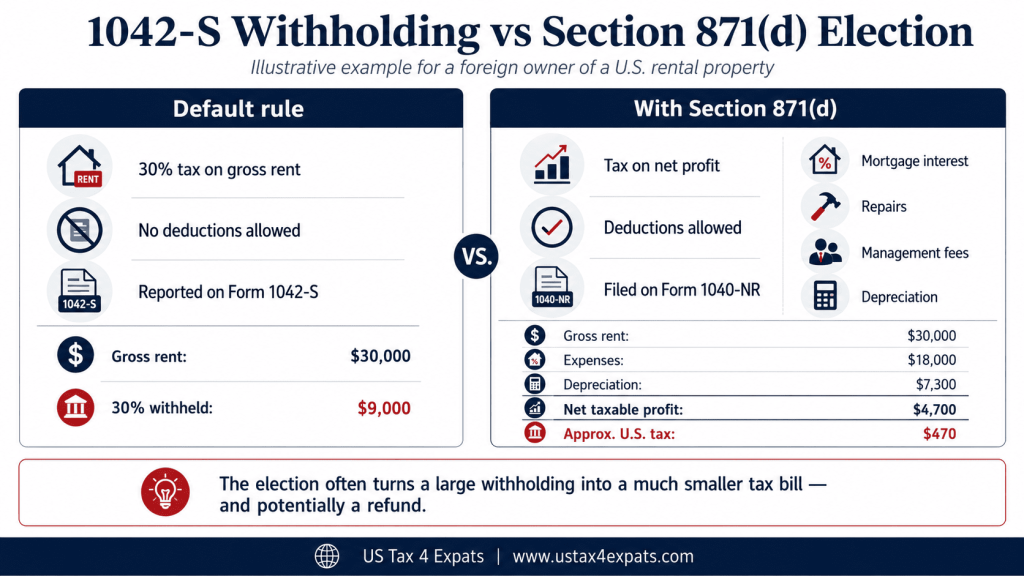
Here’s the rule that catches almost every foreign owner off guard. To the IRS, a nonresident who simply collects U.S. rent earns FDAP income — fixed or determinable, annual or periodical income — taxed at a flat 30% on the gross, with no deductions. So James’s mortgage, his management company’s cut, the cleaning between guests — none of it counts. The tax lands on every dollar of rent, not on his profit.
Because the tax is a sure thing, U.S. law makes whoever pays the rent — usually the property manager — withhold that 30% and send it to the IRS, then report it on Form 1042-S. That slip isn’t a mistake. It’s the system working exactly as designed for someone who hasn’t made an election.
What does the Section 871(d) election actually do?
Section 871(d) of the tax code lets a nonresident choose to treat U.S. real property income as if it came from a U.S. business — the technical term is effectively connected income. Once you make that choice, instead of 30% on the gross you’re taxed on your net rental profit at the same graduated rates a U.S. filer would pay, and you get to deduct the ordinary costs of running the property.
Those are the deductions any landlord would recognize: mortgage interest, property taxes, insurance, repairs, utilities, management and platform fees, and depreciation. Depreciation alone often turns a rental that “made money” on paper into a small tax loss. For how how rental deductions and depreciation work on a U.S. return, our sister site Tax & Accounting Hub lays it out in plain terms.
How much could James actually save?
I won’t guess James’s exact figure without seeing the return. But the pattern holds: a property on a thin margin — as most leveraged Airbnbs are — often shows little or no net taxable profit once real expenses and depreciation come off. Tax on a small number, or on zero, beats 30% of gross. That’s why the 1042-S so often points to a refund rather than a bill. If tax was withheld at 30% on the gross but your net-basis tax is a fraction of that, filing the return is how you claim the difference back — not by ignoring the slip.
How do you make the election — and the trap that quietly costs people their deductions?
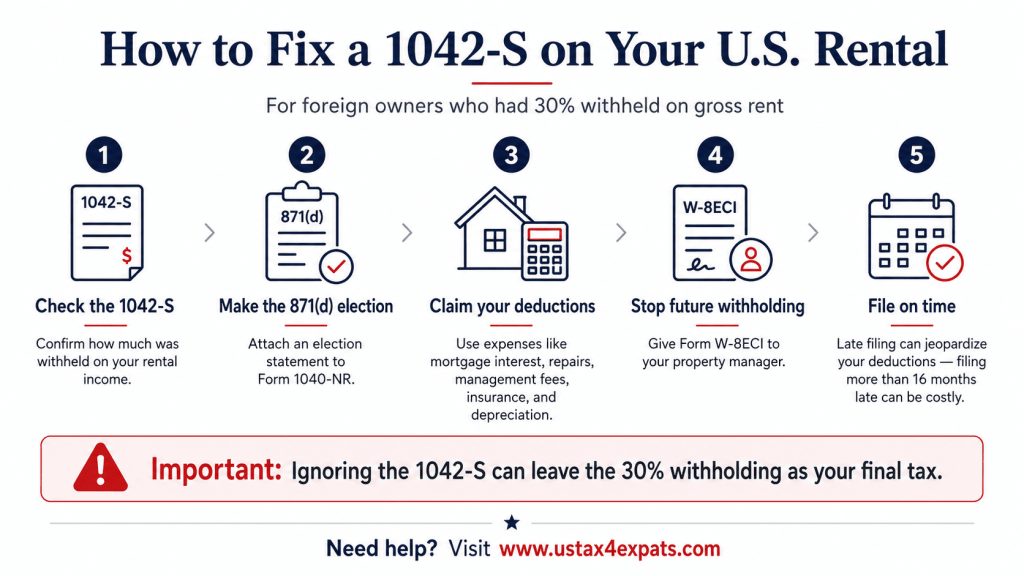
You make the 871(d) election by attaching a short statement to a Form 1040-NR, the U.S. nonresident tax return, identifying the property and electing to treat the income as effectively connected. Going forward, you give your property manager a Form W-8ECI, which tells them to stop withholding the 30% now that the income is taxed on a net basis.
Here’s the trap I’ve watched cost people dearly. File that return more than 16 months late and the IRS can deny every deduction — throwing you straight back onto the 30%-of-gross rule the election was meant to escape. The election is generous, but it rewards people who file on time.
Does the election lock James in forever?
Effectively yes, until he chooses otherwise. Once made, the election stays in force every following year until you formally revoke it. You can revoke it yourself within a limited window (generally by amending within three years of filing); after that you need IRS permission. That’s rarely a problem — net-basis taxation is almost always the better deal for a working rental, so most owners make the election once and never look back.
Worth knowing: a busy short-term rental with hotel-style services can sometimes count as a U.S. business on its own. The election still matters — it removes the guesswork and locks in net-basis treatment either way.
Key Takeaways
- Without an election, a nonresident’s U.S. rental income is taxed at a flat 30% on the gross, and the payer withholds it and reports it on Form 1042-S.
- A Section 871(d) election treats the rental as a U.S. business, so you’re taxed on net profit at graduated rates and can deduct expenses and depreciation.
- The election almost always lowers the tax sharply and often produces a refund of the 30% already withheld.
- You make it by attaching a statement to Form 1040-NR and stop future withholding with a Form W-8ECI to your property manager.
- File on time — a nonresident who files more than 16 months late can lose the deductions entirely.
Frequently Asked Questions
Can James get back the 30% already withheld on his 1042-S?
Often, yes. By filing a Form 1040-NR with the Section 871(d) election, James is taxed on his net rental profit instead of 30% of the gross. If his net-basis tax is lower than what was withheld — which is common — the difference comes back as a refund. He has to file the return to claim it.
Does James need a U.S. tax ID to file Form 1040-NR?
Yes. As a UK national with no Social Security number, James needs an ITIN (Individual Taxpayer Identification Number) to file. Our sister site ITIN CAA is the dedicated resource for getting an ITIN so a nonresident can file a U.S. return.
Does the UK–US tax treaty stop the 30% automatically?
No. The treaty lets the U.S. tax income from U.S. property and supports electing net-basis taxation — but it doesn’t switch off the 30% for you. You still make the Section 871(d) election and file. Always confirm current treaty terms for your own situation.
What happens if James just ignores the 1042-S and never files?
The 30% withheld effectively becomes his final tax, with no credit for any of his costs — and if he files very late, he can be barred from claiming deductions at all. Ignoring the slip is the most expensive option on the table.
Can James claim depreciation on a U.S. property he owns from abroad?
Yes, once the income is treated as effectively connected through the election. Depreciation on the building is one of the biggest reasons a foreign-owned rental often shows little or no taxable profit. It’s a real deduction, not a loophole.
Does making the election mean James owes U.S. self-employment tax?
Generally no. Nonresident aliens aren’t subject to U.S. self-employment tax, and residential rental income typically isn’t self-employment income anyway. The election changes how the rent is taxed, not whether it counts as a job.
Fix the 1042-S Before It Costs You Again
If you’re a foreign owner staring at a 1042-S and wondering whether you’ve handed the IRS money you didn’t owe, you’re asking the right question — and usually, yes, you can fix it. Making the Section 871(d) election, filing Form 1040-NR, and clawing back over-withheld tax for owners like James is bread-and-butter work for us. US Tax 4 Expats handles U.S. tax filing for people with cross-border ties, including nonresidents who own U.S. property. Book a consultation at www.ustax4expats.com and let’s see what your 1042-S should really have cost you.
This article is general information about U.S. tax and not personalized tax, legal, or financial advice. Tax rules, treaties, and figures change and depend on your individual situation and country of residence. Always confirm current rules and speak with a qualified professional before acting. US Tax 4 Expats is happy to help.