

Your K-1 arrives in September. It shows a loss. No cash came in. Do you still need to file a U.S. tax return?
Often, yes. A nonresident investor in a partnership carrying on a U.S. trade or business generally must file Form 1040-NR even in a loss year. Start by checking your tax status, your filing deadline and the full partnership package. Then establish whether the loss can be deducted now or must be tracked for a later year. The negative figure on your K-1 does not settle those questions.
IRS nonresident alien filing requirements | IRS 2025 partner instructions for Schedule K-1

The September email that deserves a second look
Imagine Nadia, a non-U.S. citizen living in Dubai. She invested in a U.S. property partnership. In September 2026, her 2025 Schedule K-1 arrives showing a $20,000 loss. No money has reached her bank account, so she assumes there is nothing to report.
Nadia is a fictional illustration. Her first step is to send the full K-1 package to her adviser and check whether her personal return was extended. Her next question is what happens to the loss. Those are separate decisions: a filing obligation can exist even when there is no current deduction.
First, identify which K1 you received
This article concerns Schedule K-1 from Form 1065, issued by a partnership or an LLC taxed as a partnership. Its recipient is a partner or member, even if they casually describe themselves as a shareholder.
A K-1 from Form 1120-S belongs to an S corporation. Nonresident aliens generally cannot be S corporation shareholders, so that combination needs an immediate eligibility review. A K-1 from Form 1041 belongs to an estate or trust and needs a different analysis. Do not apply this partnership guide to every document called K-1.
Living outside America does not itself make someone a nonresident for U.S. tax. U.S. citizens generally use Form 1040. Green card holders and people meeting the substantial presence test may also be U.S. tax residents. An EB-5 investor should reassess residency when immigration status changes; dual-status and treaty cases need individual review.
IRS 2025 Form 1040-NR instructions
Why a loss can still require a return
A nonresident partner is treated as engaged in a U.S. trade or business when the partnership conducts that business. A federal filing obligation can therefore exist without a cash distribution or taxable profit. The partnership return does not replace the individual partner’s return.
IRS nonresident alien filing requirements | IRS partnership overview
There are exceptions, including certain investments without a U.S. trade or business. Ask for a review of the complete K-1 package rather than assuming every foreign investor has the same obligation.
IRS nonresident alien filing requirements
Need a decision on your K-1? Visit USTAX4EXPATS and ask for a Form 1040-NR and partnership loss review. Tell us your country of residence, the tax year and whether you filed an extension. Please use an agreed secure channel for tax documents and identification numbers. Visit USTAX4EXPATS
What happens to the loss
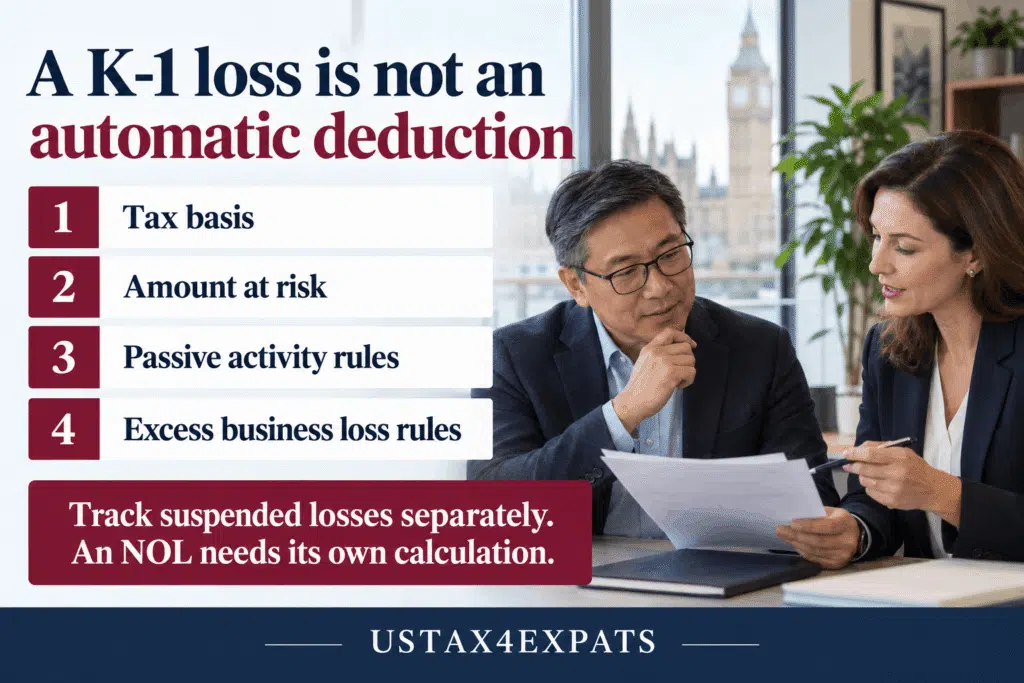
Your adviser applies several checks in order. The result may be a current deduction, a suspended loss retained for a later year, or a separately calculated net operating loss. Keep these categories separate.
IRS 2025 partner instructions for Schedule K-1
- Tax basis comes first. This is your adjusted tax investment in the partnership. Contributions, allocated income, distributions, losses and certain liabilities can change it. A K-1 capital account is not a substitute for an outside-basis calculation. A loss exceeding basis is generally suspended until sufficient basis is available.
- The at-risk rules then consider the amount you could actually lose economically. Loan arrangements matter; debt included in tax basis is not necessarily included in your at-risk amount.
- Passive activity rules can restrict losses from investments in which you do not materially participate. Rental activities have additional rules. Publicly traded partnerships generally require separate tracking for each partnership.
- The excess business loss rules can restrict otherwise allowable business losses at the individual level. Form 461 applies where required, including for Form 1040-NR filers. A disallowed excess business loss is treated as a net operating loss carryover to the following year.
A net operating loss, or NOL, requires its own calculation after applicable adjustments. It is not simply the negative figure on the K-1. Most post-2017 NOLs may be carried forward indefinitely, but their use is generally subject to an 80% taxable-income limitation. Special rules and exceptions apply.
A simple example of a suspended loss
Assume Nadia has $50,000 of outside basis before a $20,000 partnership loss, sufficient at-risk investment, and no other basis adjustments. The loss passes the basis and at-risk checks. If the activity is passive to her and she has no eligible passive income or other exception, the $20,000 is generally suspended under the passive activity rules.
Her outside basis is generally reduced to $30,000 even though the passive loss is not currently deductible. The $20,000 must remain separately tracked. If the same activity later produces $12,000 of qualifying passive income and the facts otherwise stay unchanged, that income may absorb $12,000 of the suspended loss, leaving $8,000. This example is illustrative, not a promised tax saving.
IRS Publication 541 | IRS Form 8582 instructions
That is why a well-prepared loss-year return and supporting records matter. Filing documents the position; it does not override the loss limitations or guarantee a future deduction.
A September K1 does not extend your deadline
A calendar-year partnership with a valid extension commonly provides its K-1 around its September filing deadline. Your personal return has its own timetable. The partnership’s extension does not extend yours.
IRS Form 1065 instructions | IRS Form 4868 and instructions
| 2025 individual filing position | Regular due date | With timely six-month extension |
| Employee wages subject to U.S. income tax withholding | 15 April 2026 | 15 October 2026 |
| No employee wages subject to U.S. income tax withholding | 15 June 2026 | 15 December 2026 |
These are ordinary dates for 2025 calendar-year individual returns, assuming a valid timely Form 4868 extension where shown. Special relief can change a date. An extension to file generally does not extend the time to pay.
IRS 2025 Form 1040-NR instructions | IRS Form 4868 and instructions
If September arrives and you did not obtain an extension, act promptly. Do not assume that a late K-1 automatically excuses late filing, or wait until next year. If you already filed, ask whether the new information requires an amended return. Keep the original filing and extension acknowledgements.
Can late filing put deductions at risk
Yes. Nonresident filing rules can deny deductions against effectively connected income when a true and accurate return is not filed within the applicable time limit. Publication 519 discusses a special 16-month rule, circumstances that can shorten that period, and possible relief. It is not a routine extension and should never be used as a reason to delay.
A protective Form 1040-NR may be appropriate where a person reasonably believes there is no effectively connected income but wants to preserve deductions if that conclusion changes. It is not a substitute for properly reporting known business income and losses.
Check withholding as well as losses
Form 8805 reports a foreign partner’s allocated income and section 1446 withholding credit. Reconcile it with the full partnership package and your return. Withholding may exceed the final liability and support a refund claim, but a loss on one K-1 does not prove that all withholding will be refunded. Different items and investments can affect the final result.
IRS Forms 8804 and 8805 instructions
What to gather before your review
- Every K-1 and attachment, any Schedule K-3 provided, Form 8805, and state tax schedules.
- Prior U.S. returns and separate basis, at-risk, passive loss, and NOL schedules.
- Capital contributions, cash and property distributions, loans and investment sale records.
- Extension confirmations, tax payments, immigration status and U.S. travel dates.
Your adviser can then decide which items belong on Schedule E and other schedules, which limitations apply, and whether state filings or treaty disclosures need attention. Avoid entering only the headline loss and ignoring the attachments.
IRS 2025 partner instructions for Schedule K-1

Help for overseas investors and their advisers
Whether you live in Singapore, Doha in Qatar, Dubai in the UAE, Bangalore (Bengaluru), Chennai or elsewhere in India, begin with your U.S. tax status and investment documents. The same starting point applies to readers in Belgium, France, Monaco and Saudi Arabia. Your address alone does not determine which U.S. return you file.
Your country of residence and your U.S. filing status
A U.S. citizen living in any of these places generally files Form 1040 rather than Form 1040-NR. This guide focuses on nonresident investors with partnership K-1s. If you are unsure which group you fall into, ask for a residency review before preparing the return.
IRS guidance on resident and nonresident status
For readers in the UK, Canada, Australia and other countries, keep the U.S. analysis separate from your local return. Give both advisers the same K-1 package and loss schedules. Do not assume that a loss deferred in the United States receives identical treatment where you live.
For investors: visit USTAX4EXPATS to discuss your Form 1040-NR, late K-1 and loss records. A useful first message is “I received a 2025 partnership K-1 in September and need my filing position reviewed.” Visit USTAX4EXPATS
For accountants, wealth advisers and family offices: contact USTAX4EXPATS to discuss support with a client’s nonresident U.S. return and partnership reporting. Identify the entity type, residence country, missing schedules and filing deadline at the outset. Visit USTAX4EXPATS
Frequently asked questions
I live in India or the Gulf so should I file Form 1040NR
Residence abroad alone is not enough to decide. A U.S. citizen generally files Form 1040; a nonresident alien with a U.S. partnership investment may need Form 1040-NR. Green card, substantial presence, dual-status and treaty cases require individual review.
Do I need Form 1040NR if my K1 shows a loss
Generally yes if you are a nonresident alien engaged in a U.S. trade or business, including through a partnership. A loss does not remove that obligation. Exceptions need a separate review.
IRS nonresident alien filing requirements
Does filing automatically carry my loss forward
No. The adviser must establish the loss type, apply the relevant limitations and keep supporting schedules. Filing alone does not create basis, economic risk or an allowable deduction.
IRS 2025 partner instructions for Schedule K-1
Can I skip filing because I received no cash
A partnership can allocate taxable income without making a distribution. Cash received and taxable allocations are different; check the full K-1.
Is every K1 loss a net operating loss
No. Basis-suspended and passive losses are different from an NOL. An NOL is calculated separately using the applicable tax rules.
Is my deadline always October 15
No. For a 2025 calendar-year Form 1040-NR, a qualifying June 15, 2026 filer with a timely six-month extension generally has until December 15, 2026. Verify your own filing category.
What if my K1 arrives after I have already filed
Send it to your preparer promptly. They should compare it with the filed return and decide whether an amendment or other corrective reporting is required.
Can I offset a partnership loss against all my income
No. The character of the income and the applicable restrictions matter. Passive losses generally cannot offset salary or portfolio income, and publicly traded partnerships have separate rules.
Does Form 8805 replace my personal return
No. It supports your section 1446 withholding credit. You still need to determine your individual filing obligation and reconcile the credit.
IRS Forms 8804 and 8805 instructions
Can a nonresident shareholder own an S corporation
A nonresident alien generally cannot be an S corporation shareholder. If your K-1 says Form 1120-S, obtain advice on eligibility and residency before applying partnership guidance.
Do you provide ITIN application services
We do not currently offer ITIN application services. If you lack a required U.S. taxpayer identification number, raise that early so the filing process can be planned appropriately.
Who should review multiple K1s
Ask a U.S. tax adviser to review them together with your prior loss schedules and foreign residence position. An accountant or family office can coordinate the records with your consent.
Related services across our sister websites
For broader personal tax information, visit Tax and Accounting Hub. You can also view the Tax and Accounting Hub services website. For enquiries about this article and your partnership K-1, use USTAX4EXPATS below.
Arrange your K1 review
A loss-year K-1 deserves a proper review. Visit USTAX4EXPATS to discuss your filing deadline, the documents needed and how your losses should be recorded. Adviser and family-office enquiries are welcome. Visit USTAX4EXPATS
General information only, prepared on 19 September 2026 with 2025 return examples. This article is not personalised tax, legal or investment advice and does not create an adviser-client relationship. Rules, treaties and deadlines may change, and federal, state and foreign treatment may differ. Obtain advice based on your complete circumstances before acting. Examples are fictional; no deduction, refund or tax outcome is guaranteed.